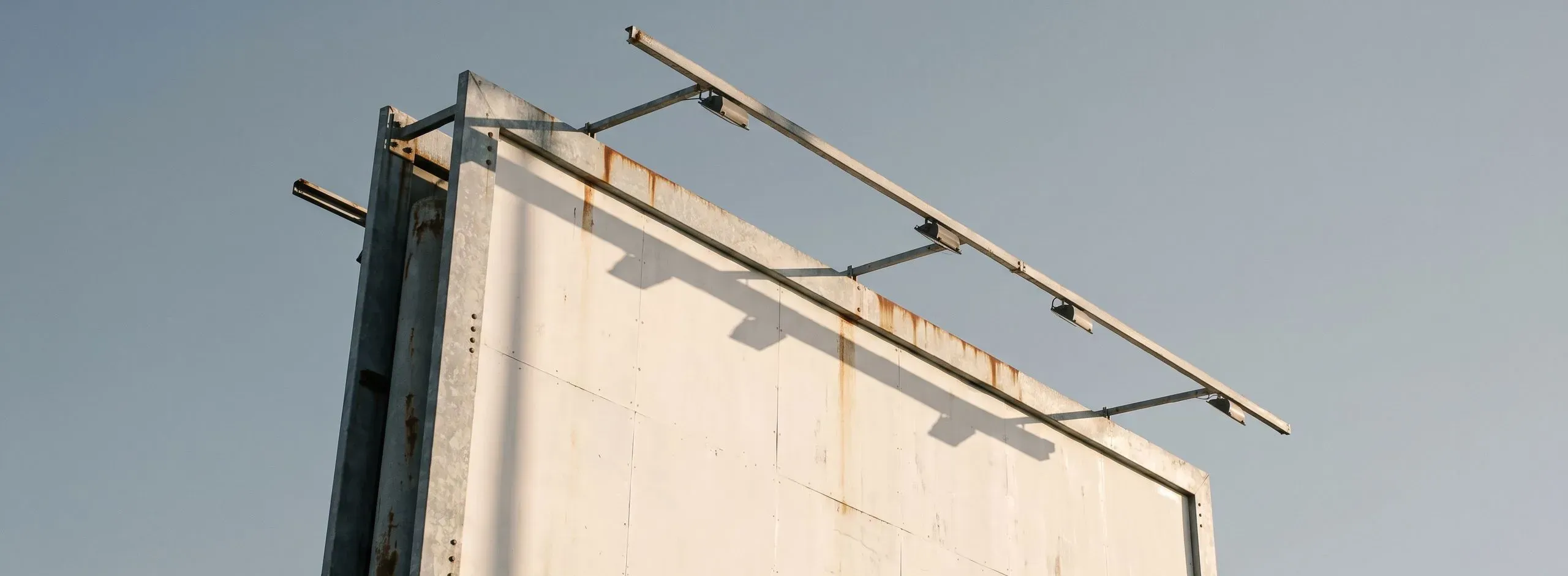
Offering advertising space
Sightlines, visibility, lighting and fixing: what makes an advertising space valuable, and why the permit question comes before everything else.
· مدة القراءة 3 دقيقة
هذا الدليل متاح بالألمانية والإنجليزية. أنت تقرأ النسخة الإنجليزية.
With an advertising space, the operator is not paying for square metres but for eyes on it. Everything that makes a listing usable follows from that: who sees the face, from where, for how long, and in what light.
First: the permit question
Advertising installations are relevant under building law depending on size, type and location, and whether a permit is needed follows state law and local by-laws. That can range from permit-free to requiring planning permission, with extra rules in town centres, near listed buildings and along classified roads.
We cannot tell you which applies and are not permitted to. What we can say: settle it with your local authority before committing a space. And write what you know into the listing. A host who notes "permit in place" or "permit would need to be obtained" spares the other side the least pleasant part of the research.
What determines the value
The sightline. What counts is not how large the face is but who looks straight at it. A gable wall on a junction is seen by every queue of waiting traffic; an equally large wall on a side street by almost nobody.
Name the direction the face is seen from and what happens there: a main road, a traffic light, a station forecourt, a car park entrance.
Distance and angle. From what distance is the face legible, and how obliquely does it sit to the direction of travel. Both affect what design works at all.
Traffic rather than residents. For advertising, through traffic and vehicle movements count for more than the number of people living nearby. If you know a rough order of magnitude, because it is a known through route for instance, write it as context rather than as a figure you would have to stand behind.
Shading and growth. A tree that covers half the face in summer belongs in the listing. It will be obvious at a site visit at the latest.
Technical points and fixing
Lighting. A lit face works considerably longer each day. Say whether lighting is present, whether it works, and who pays for the electricity.
Power supply. No power means no lighting and no digital display. Where is the nearest connection, and is a separate meter possible.
Substrate and fixing. What is being fixed to: masonry, concrete, sheet metal, timber. Is there an existing subframe that could be used. Anyone who allows no drilling is better off saying so beforehand.
Access for installation and changes. Can a lift platform reach it, is there an approach, does anything need closing off. That decides the operator's running costs and therefore the price they can pay.
What belongs in the conversation
Three points that do not fit sensibly into a listing.
Whether you may dispose of it at all. Tenancies, owners' associations and listed facades all require consent. That is your affair, but it becomes a shared one if it later turns out otherwise.
What may be shown. Some hosts want certain advertising content excluded. If that matters to you, raise it before committing, not after the first change of artwork.
Who removes it. After the term a subframe remains, and the wall beneath looks different from the wall beside it. Settle who removes and who makes good.
The full list of questions is in From unlock to contract. What is written here is orientation for your listing and replaces neither a planning enquiry nor legal advice.
الأسئلة الشائعة
- Do I need a permit for an advertising installation?
- It depends on size, type and location, and in Germany it is state law. Planning permission may be required. Settle it with your local authority before you commit.
- Does the space have to be lit?
- No, but lighting extends visibility considerably. If power is available, that belongs in the listing.
- Does size or location matter more?
- Location. A smaller face on a busy junction is usually worth more than a large one on a side street.
- Can I offer a wall I do not own?
- Only with the owner's consent. For tenancies and owners' associations that has to be obtained beforehand.
- What about digital displays?
- Those need power and usually a data connection. Name both if present; it widens the field of interested operators.