
Writing messages and answering enquiries
How the inbox is laid out, what a first enquiry should contain, and what to do when a conversation goes wrong.
· 2 min de lecture
Ce guide existe en allemand et en anglais. Vous lisez la version anglaise.
Every conversation runs through the inbox. It is organised by conversation rather than by message: each row is one space and one counterpart.
How the inbox is laid out
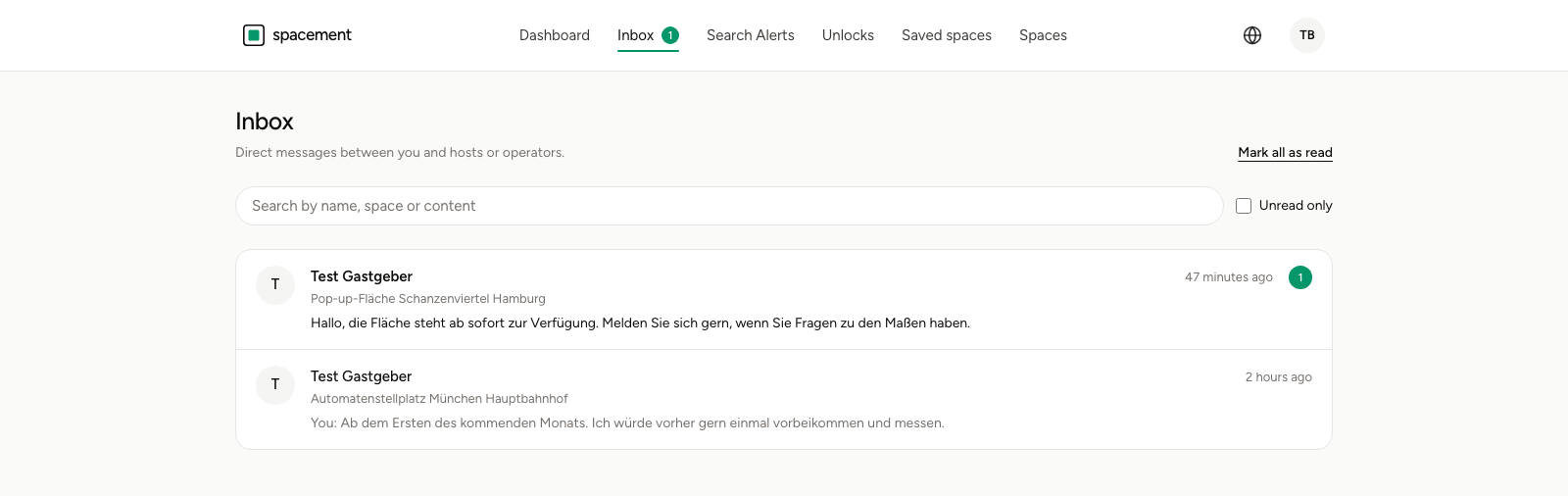
A search field across the top covering names, spaces and message content, next to it the Unread only toggle and Mark all as read.
Each row shows who you are talking to, which space it concerns, a snippet of the last message and how long ago it arrived. Anything unread carries a count on the right.
If a conversation says Space removed, the host has withdrawn the listing. The history stays readable, but you cannot reply to it any more.
A first enquiry that gets answered
Hosts receive enquiries from people they do not know, about a space they know well. What makes the difference is whether the first message makes clear what this is about.
Four things help: what you want to install or use the space for, how much room that takes, from when, and for how long. Four sentences will do. A message that only asks "is this still available?" forces the other side to ask back, and that is exactly where conversations stall.
For hosts: replying
Enquiries reach you by email and in the inbox. You reply in the thread itself, and your reply triggers a notification the other way.
You do not have to hand over everything at once. If you left the contact fields empty when publishing, contact runs through here alone, and you decide during the conversation when to give out a phone number or an address.
When access is missing
Operators need active access to reply. If the subscription lapses, conversations stay readable but the reply field points out that access has to be reactivated. This does not apply to hosts, who always write for free.
When something goes wrong
Two routes that do different things.
Report message sends the case to us and we look at it. That is the route for fraud, for inappropriate content, or when somebody tries to route around the directory.
Block user ends the contact immediately and in both directions. It is your own call, needs no justification, and you can undo it in your settings whenever you like.
A listing itself is not reported here but on its own page, via Report listing, with a reason ranging from misleading through wrong location to suspected fraud.
What Spacement does with messages
Messages are not end-to-end encrypted, so technically they are readable. They are only read when there is a reason, a report for instance, and every access is logged. How Spacement protects your data goes into more detail.
Questions fréquentes
- Does the other side get an email when I write?
- They get a notification. The message itself stays in the inbox, and that is where replies happen.
- Can hosts write first?
- Conversations start at a space. Hosts reply to enquiries; the first move belongs to the operator.
- What happens when my access lapses?
- Conversations stay readable, but you cannot reply until access is active again. A note in the thread tells you so.
- Are messages end-to-end encrypted?
- No. Technically they are readable. They are only read when there is a reason, a report for instance, and every access is logged.
- What is the difference between reporting and blocking?
- Reporting sends the case to us for review. Blocking ends the contact immediately, is entirely your call, and can be undone at any time.