Photos and descriptions that bring enquiries
What a usable photo shows, what order the images should be in, and the four details every description needs.
· Czas czytania: 3 min
Ten poradnik jest dostępny po niemiecku i angielsku. Czytasz wersję angielską.
A listing has two jobs: get seen and save follow-up questions. The photos do the first, the description the second. Both are quicker than most people assume.
What a usable photo shows
The space itself, not the building from across the street. An operator wants to know where their machine, their pop-up or their installation would stand, and for that they need a view of exactly that spot.
Three things make the difference:
Light. Shoot during the day and switch on whatever is there. A dark image reads as a dark room, even if the room is bright.
Framing. Hold the camera at eye level and keep it straight, so vertical edges stay vertical. Shots from an angle above make rooms tip and spaces look smaller.
Context. An image showing nothing but a bare wall says nothing about size. Include the surroundings: the door beside it, the corridor in front, the window.
Phone cameras are entirely adequate for this. What is not adequate: shots in the dark, flash fired straight at glass, or half-closed shutters.
How many and in what order
Three at least, ten at most. Three good ones beat ten arbitrary ones.
The order is not incidental: the first image appears in the result list and decides whether anyone clicks at all. It should show the space most clearly. After that, sensibly: the surroundings, the access, and anything technical such as connections.
Large files are compressed on upload, so there is nothing to prepare.
The four details every description needs
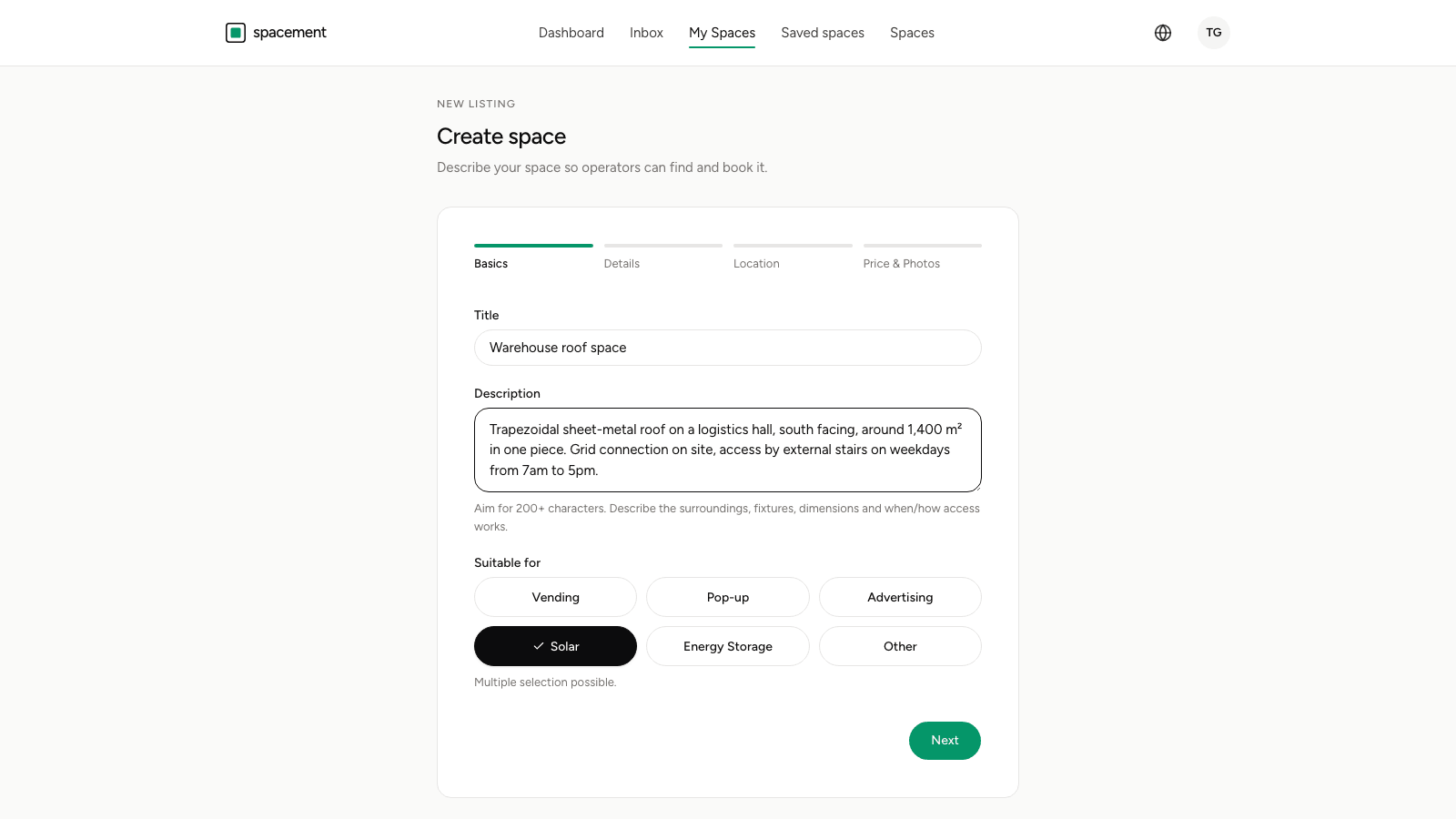
The form says it itself: the surroundings, the fittings, the dimensions, and when and how access works. Anyone who works through those four has a usable description, however little they enjoy writing.
The surroundings means not the address but what goes on around it. Who comes past, at what times, what is next door.
The fittings are what an operator would otherwise have to ask about: power, water, internet, lighting, parking.
The dimensions in metres, not only in square metres. Twelve square metres can be three by four or one by twelve, and for a piece of equipment that is the difference.
Access as specifically as possible. Not "by arrangement" but the hours when no arrangement is needed, and how you get in.
The trick with follow-up questions
The best description does not come from writing but from the first enquiries. Note what people ask you. Anything asked three times belongs in the listing.
After a few weeks the description is better than it could have been on day one, and the enquiries get more specific. You can change it whenever you like, see Editing, pausing and deleting a space.
What not to leave out
A low ceiling, a step at the entrance, building work next door, a roof due for renewal in three years. All of it will be obvious at a site visit at the latest.
Said in advance, it costs you a few enquiries from people it would not have suited anyway. Discovered afterwards, it costs the conversation both sides already put time into. What actually counts for a given use type is in What makes a good vending location and Offering roof space for solar.
Częste pytania
- How many photos do I need?
- Three at least, up to ten. Three good ones beat ten arbitrary ones.
- Is a phone photo enough?
- Yes. Light and framing decide, not the camera. A bright phone photo beats a dark SLR one.
- Which photo should come first?
- The one that shows the space itself most clearly. It is the image that appears in the result list and decides whether anyone clicks.
- How long should the description be?
- The form suggests 200 characters and up. More important than length is that the usual follow-up questions are answered in it.
- Should I mention flaws?
- Yes. Anything that will be obvious at a site visit costs you nothing to mention beforehand and saves an abandoned conversation later.